The AE86 Hachi-Roku: how a humble Toyota became the drift iconハチロク(AE86):ありふれたトヨタがドリフトの象徴になるまでThe AE86 Hachi-Roku: how a humble Toyota became the drift icon
A light, rear-wheel-drive 1980s Toyota coupé, a mountain-pass legend and a manga about tofu deliveries. This is the story of the car we put you in.1980年代の軽量な後輪駆動のトヨタ・クーペ、峠の伝説、そして豆腐の配達を描いた漫画。あなたを乗せるクルマの物語です。A light, rear-wheel-drive 1980s Toyota coupé, a mountain-pass legend and a manga about tofu deliveries. This is the story of the car we put you in.
The car
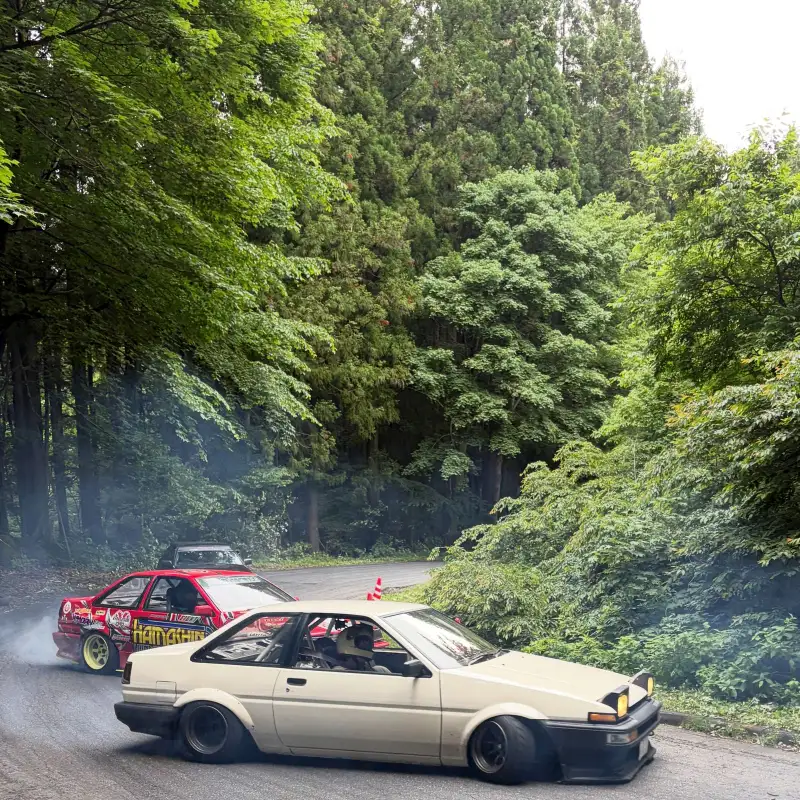
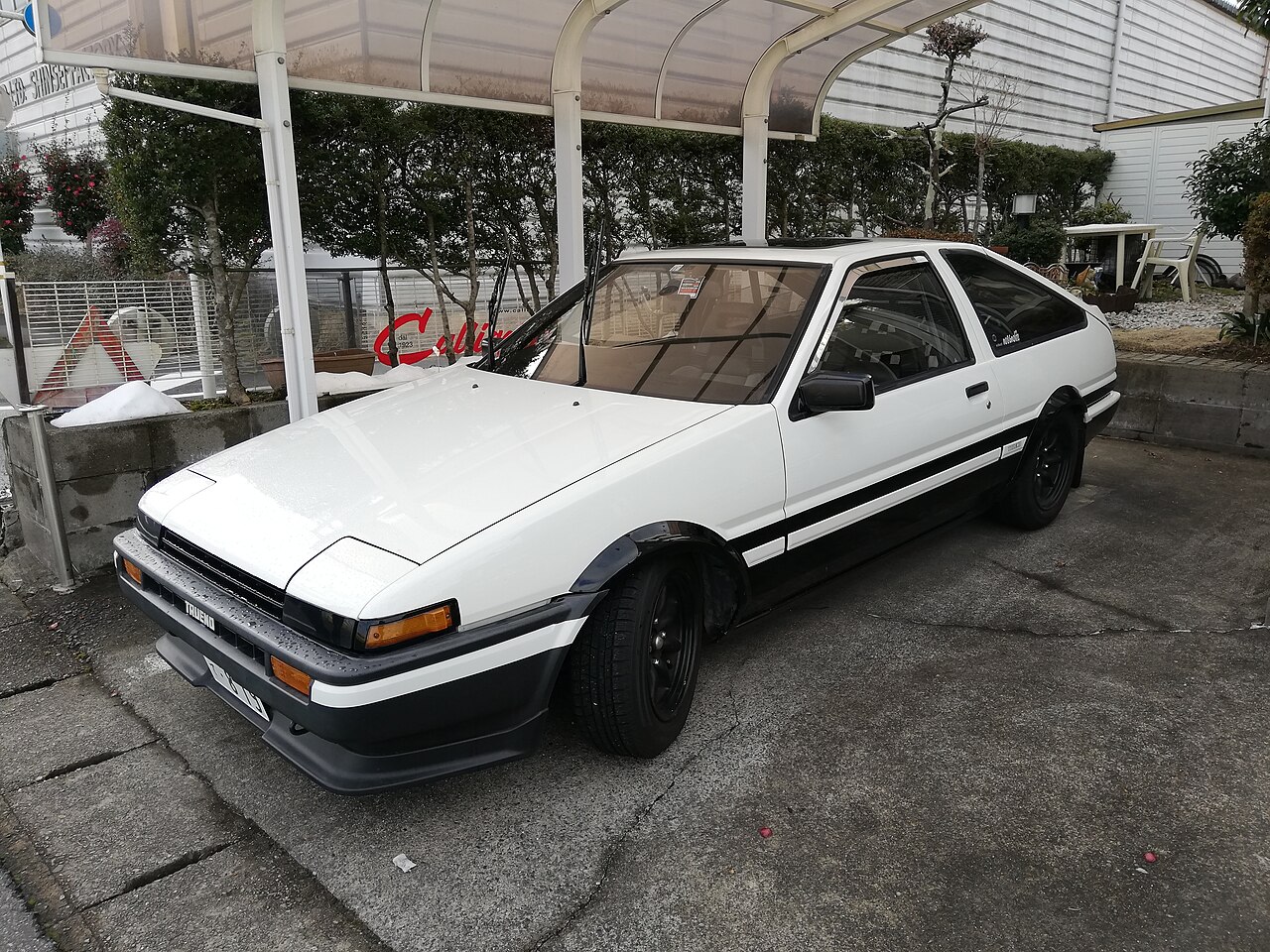
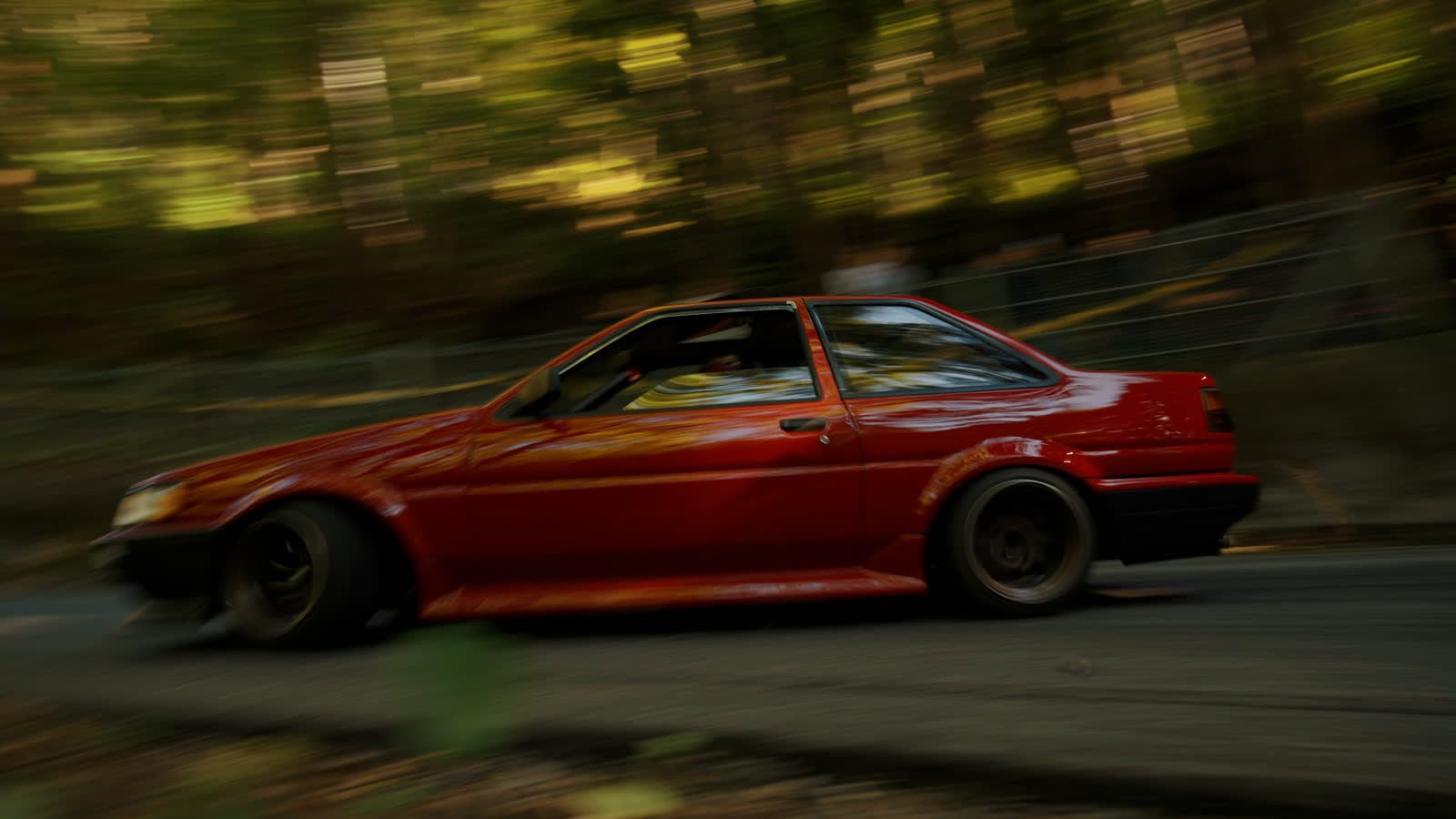
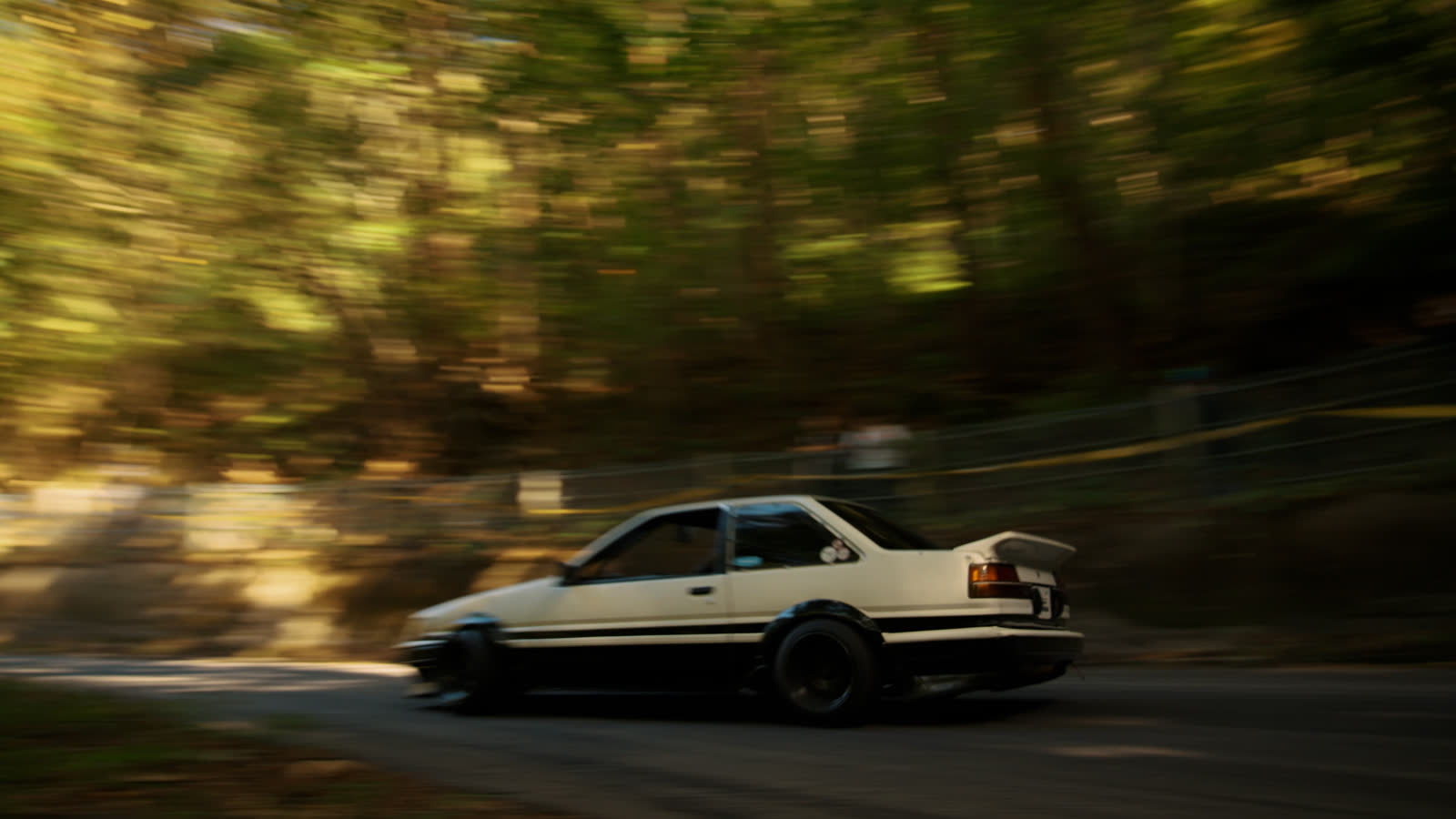
The AE86 is the chassis code for the Toyota Corolla Levin and Sprinter Trueno, built from 1983 to 1987. The two were near twins: the Levin had fixed headlights and the Trueno had pop-ups, and both came as a coupé or a liftback. Under the bonnet, the Japanese-market car had a 1.6-litre twin-cam 4A-GE engine rated at 130 PS, and the whole car weighed roughly 900 to 1,065 kg, depending on version, per Wikipedia.
The key fact for drifters: it was the last rear-wheel-drive Corolla. The rest of that generation moved to front-wheel drive, which left the AE86 as a small, light, cheap, rear-driven coupé. In Japan it is called Hachi-Roku, simply “eight-six”.

Where drifting came from
Drifting grew out of Japan’s mountain-pass (touge) driving in the 1970s. Former motorcycle racer Kunimitsu Takahashi is credited with developing its techniques on the track, and a young Keiichi Tsuchiya, inspired by him, practised on mountain roads until he became a street-racing legend and earned the nickname Dorikin, the Drift King (Wikipedia: Drifting, Wikipedia: Keiichi Tsuchiya).
In 1987 a video of Tsuchiya’s touge driving in his own Trueno, released by Pluspy, became a hit and influenced a generation of drivers. A year later he helped organise Ikaten, one of the first events dedicated to drifting. Drifting then spread abroad after a 1996 demonstration at Willow Springs in California, and a professional series, the D1 Grand Prix, followed in Japan. Enthusiast sites tell the 1987 story in more detail, for example Petrolicious.

Initial D and MF Ghost
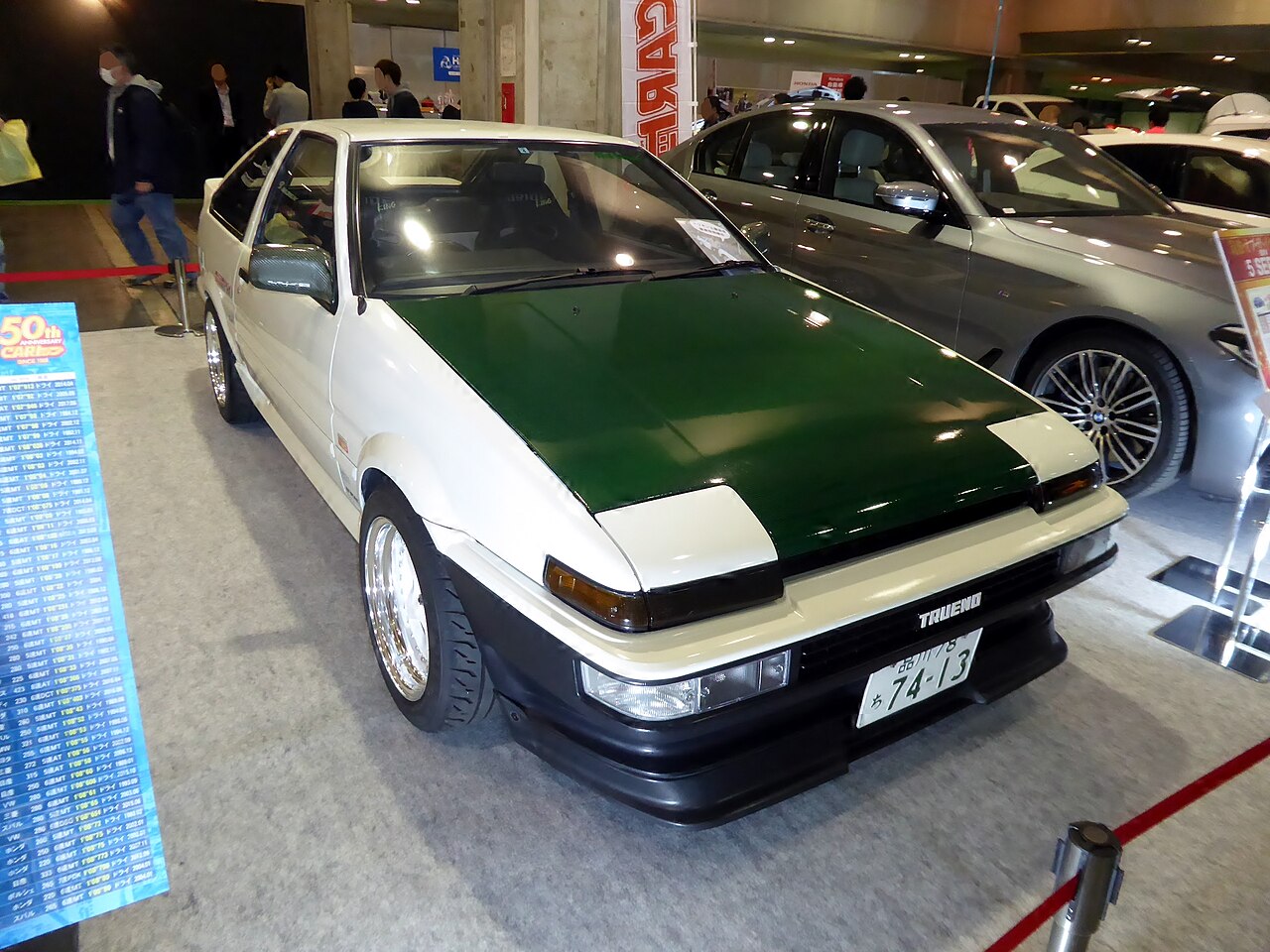
In 1995 manga artist Shuichi Shigeno began Initial D in Kodansha’s Weekly Young Magazine. Its hero, Takumi Fujiwara, is a Gunma teenager who masters mountain passes while delivering tofu in his father’s old Sprinter Trueno. The story is set on Gunma’s passes, some names fictionalised but based on real places, and Keiichi Tsuchiya helped supervise it. The series sold more than 55 million copies and led to anime, a live-action film and many arcade games. Its sequel MF Ghost ran from 2017 to 2025 (Wikipedia: Initial D). The car’s fame, and its resale prices, climbed with it.
The default car: stock reference specs
Every drift-day car is a modified AE86 with its own build, and each date’s line-up is published. So here is the stock Japanese-market car they all start from, per Wikipedia and Wikipedia: Toyota A engine.
| Engine | 1.6 L (1,587 cc) DOHC 16-valve 4A-GEU, 9.4:1 compression, naturally aspirated |
|---|---|
| Layout | Front engine, rear-wheel drive, T50 5-speed manual, optional limited-slip differential |
| Wheelbase and size | 2,400 mm wheelbase, about 4,185–4,215 mm long, 1,625 mm wide, 1,335 mm high |
| Suspension | MacPherson struts at the front, four-link live axle at the rear, front and rear anti-roll bars |
| Weight balance | Close to 50/50 front to rear |
Power-to-weight is 130 PS divided by 0.9 to 1.065 tonnes. Wikipedia gives no official 0–100 km/h time, so we don’t quote one.
Why it feels the way it does
Power-to-weight
About 120–145 PS per tonne from a 1.6-litre. Not fast on a straight, but the car has so little to move that the engine is always working.
Instant response
A naturally aspirated twin-cam with no turbo to spool. The throttle answers straight away, and the engine pulls to a redline of roughly 7,500–7,800 rpm, so you keep it in the high revs.
Nimble
A short 2.4 m wheelbase and around 900 kg mean the car changes direction quickly and rotates with little effort. It is easy to send sideways and easy to catch.
Balance
Near 50/50 weight, rear-wheel drive and an optional limited-slip differential give a car you steer with the throttle, which is why it teaches drifting so well.
16-valve, 20-valve and race spec
The AE86 left the factory with the 16-valve 4A-GE. Many owners swap in the later 20-valve versions, and racers go much further. Typical figures:
| Engine | 16V 4A-GEU (AE86, 1983–87) | 20V Silvertop (AE101, 1991–95) | 20V Blacktop (AE111, 1995–2000) | Group A race AE86 |
|---|---|---|---|---|
| Power | 130 PS at 6,600 rpm | 160 PS at 7,400 rpm | 165 PS at 7,800 rpm | about 175 PS at 9,200 rpm |
| Torque | 149 Nm at 5,200 rpm | 162 Nm at 5,200 rpm | 162 Nm at 5,600 rpm | not published |
| Compression | 9.4:1 | 10.5:1 | 11.0:1 | not published |
| Redline | about 7,600 rpm | 7,800 rpm | 8,200 rpm | 9,200 rpm (peak power) |
| Valves and cam | 4 per cylinder, no variable cam | 5 per cylinder, variable intake cam | 5 per cylinder, variable intake cam | 16V with approved cams, pistons and ECU |
| PS per tonne in an AE86* | 122–144 | 150–178 | 155–183 | 164–194 |
*130–175 PS divided by 0.9 to 1.065 tonnes, the stock AE86 weight range. Swaps change the weight and race cars are lighter, so treat this as a guide. Engine figures from Wikipedia: Toyota A engine; the Group A figure from Web Motor Magazine.
What “race spec” means. In Group A touring-car racing in 1980s Japan, the AE86 Levin ran in the 1.6-litre Division 1 class. Teams could fit approved camshafts, pistons and engine electronics, which raised output to about 175 PS at 9,200 rpm, and had to keep the stock MacPherson front and rigid rear axle layout, with stiffer springs and dampers, shorter final drives and bigger-diameter tyres. At the 1985 Inter TEC, nine of the 38 starters were AE86s, and an Advan-backed Corolla driven by Keiichi Tsuchiya and Keiichi Suzuki ran with larger cars. Full-tune builds go further: one dealer listing for an N2-spec car claims about 250 PS, though that is a single car, not a standard. Drift cars have no single spec: builds vary widely, which is why we publish each car’s build for every date.
Why a lightweight rules the touge
On a narrow mountain road you rarely get to use big power. What counts is how little car you have to slow, turn and throw into the next corner. That is the AE86’s whole case.
| Car | Power | Weight | PS per tonne |
|---|---|---|---|
| AE86 stock (16V) | 130 PS | 900–1,065 kg | 122–144 |
| AE86 NA circuit builds, average of five | about 208 PS | about 804 kg | about 259 |
| AE86 CBY 5.5A-G | 220 PS | about 800 kg | about 275 |
| Skyline GT-R R32 / R33 / R34 | 280 PS (published) | 1,430 / 1,530 / 1,560 kg | 196 / 183 / 180 |
| Supra A80 twin turbo / NA | 280 / 223 PS | 1,490–1,570 / 1,410–1,510 kg | 178–188 / 148–158 |
| RX-7 FD Type R (final) | 280 PS | 1,310 kg | about 214 |
| GR86 (2022+) | 231–235 PS | 1,270–1,307 kg | 177–185 |
Sources: Skyline GT-R, Supra, RX-7, GR86, AE86 and the build sources in the table above. Nissan’s 280 PS GT-R figure is a published number under the Japanese “gentlemen’s agreement”; tests suggest the R34 made about 332 PS, which is about 213 PS per tonne. Builds use mixed measurement conditions.
Entry speed and braking, honestly
An 800 kg AE86 carries roughly half the kinetic energy of a 1,560 kg R34 at the same speed, so its brakes have half as much to shed on every corner. They run cooler, fade later and stay consistent down a long descent. With near 50/50 weight and a short wheelbase, there is also less weight to shift under braking, so the car stays settled and can be rotated on the brakes. Stopping distance on the same tyres is set by grip, not mass, so the AE86’s edge is repeatability and how late and how confidently a good driver can brake, not a magic shorter stop. On a tight road, cornering speed is limited by grip, which is why a 200–220 PS AE86 stays close to far more powerful cars.

Lap-time proof, with caveats
| Car at Tsukuba TC2000 | Time |
|---|---|
| Honda NSX (NA1), tuned, Nobuteru Taniguchi | 53.474 s |
| Skyline GT-R (BNR34), tuned | 54.481 s |
| Supra (JZA80), tuned | 55.458 s |
| Honda Civic (EK9), tuned | 55.964 s |
| AE86 “Kumomaka”, about 200 hp, 800 kg | 57.063 s |
| AE86 CBY 5.5A-G, naturally aspirated, 220 PS | 58.6 s |
| AE86 “Carbon Junkie”, naturally aspirated, 220 PS | 59.234 s |
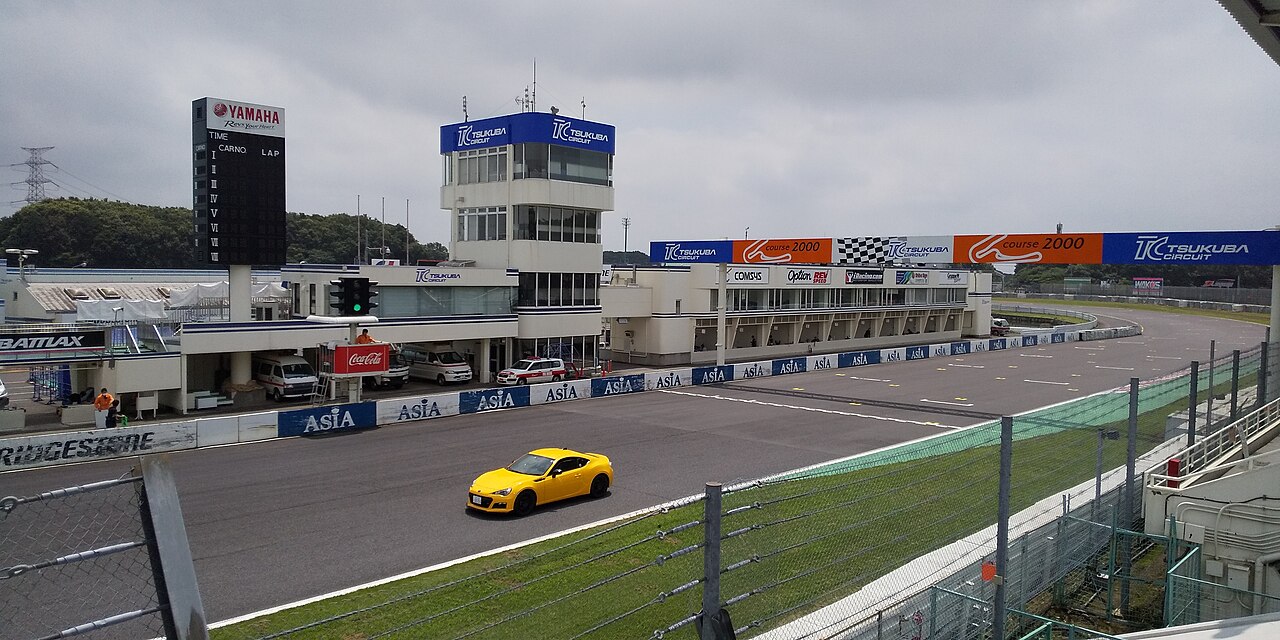
Tuned-car times are from the time-attack table on Wikipedia: Tsukuba Circuit (street-tyre tuner cars; power not listed there). AE86 times: Motor Fan, The Drive, and a Speedhunters report of the Kumomaka car (Attack Tsukuba 2021). Tyres, conditions and years differ, so read this as a rough guide: the naturally aspirated AE86 is within about 3 to 5 seconds of tuned GT-Rs and Supras on a 2 km lap.
The touge originals
The proof is older than the game. In Japan’s 1985 Group A Inter TEC, nine of the 38 starters were AE86s, and the Advan Corolla of Keiichi Tsuchiya and Keiichi Suzuki kept pace with and passed bigger-engined cars (Web Motor Magazine). Tsuchiya then made the car a touge legend on the mountain roads, and Initial D put a tofu-delivery Trueno on those same Gunma passes (Wikipedia, Wikipedia). That is why the Hachi-Roku is still the car people mean when they say touge.
Everything side by side
Every build and reference car on this page in one table. Power-to-weight is published power divided by weight; Tsukuba times are TC2000 laps.
| Car | Power | Weight | PS per tonne | Tsukuba lap |
|---|---|---|---|---|
| AE86 builds, naturally aspirated | ||||
| CBY 5.5A-G (1.8 L, Hayabusa throttle bodies) | 220 PS | about 800 kg | 約275 | 58.6 s |
| “Carbon Junkie” (16V 4A-GE) | 220 PS | under 800 kg | 約275以上 | 59.234 s |
| Koizumi Shokai N2 (1.75 L, carburettors) | 220 PS | 810 kg | 約272 | 59.7 s |
| “Kumomaka”* | 200 hp | 800 kg | 約250 | 57.063 s |
| Mansaku Jidousha Trueno* | 約180 hp | 810 kg | 約222 | 約60.0 s |
| Tech Art street-comfort build | 230 PS | not stated | — | — |
| Sasaki, late AE92 head | 160 PS | not stated | — | — |
| Owner-built AE111 20V swap | 158 PS | not stated | — | — |
| AE86 reference | ||||
| Stock 16V 4A-GEU | 130 PS | 900–1,065 kg | 122–144 | — |
| Group A race AE86 | 約175 PS | not stated | — | — |
| Tuned reference cars (Tsukuba, semi-slicks) | ||||
| Honda NSX (NA1) | not listed | not listed | — | 53.474 s |
| Skyline GT-R (BNR34) | not listed | not listed | — | 54.481 s |
| Supra (JZA80) | not listed | not listed | — | 55.458 s |
| Civic (EK9) | not listed | not listed | — | 55.964 s |
| Stock road cars | ||||
| Skyline GT-R R32 / R33 / R34 | 280 PS (published) | 1,430 / 1,530 / 1,560 kg | 196 / 183 / 180 | — |
| Supra A80 turbo / NA | 280 / 223 PS | 1,490–1,570 / 1,410–1,510 kg | 178–188 / 148–158 | — |
| RX-7 FD Type R (final) | 280 PS | 1,310 kg | 約214 | — |
| GR86 (2022+) | 231–235 PS | 1,270–1,307 kg | 177–185 | — |
*Figures from search-result snippets of Speedhunters articles that we could not open; treat as unconfirmed. Power units are as published (PS or hp), conditions differ between sources, and the tuned cars’ power is not listed in the Tsukuba table. Sources: Motor Fan, Motor Fan, The Drive, Motor Fan, Automesse Web, Motor Fan, Wikipedia: Tsukuba Circuit, AE86, GT-R, Supra, RX-7, GR86.
The short version: the naturally aspirated circuit AE86s carry about 250–275 PS per tonne, roughly 40–50% more than the best stock road car here, yet lap Tsukuba 2.5 to 6 seconds behind far more powerful tuned cars. That mix of light weight, balance and revs is why it is the touge benchmark.
AE86s at Gunsai: what the videos show
Japan’s car videos have been settling the argument at Gunsai for years. Here is what is on record about AE86s there, wins and losses included. We link to the videos instead of embedding them, so you watch them at the source.
- 2003, Best MOTORing: the first Touge Saikyo Densetsu final. In the class up to 200 PS, the publisher’s own page says Tsuchiya’s AE86 won the final, against entries including a Spoon Civic EG6, a Techno Pro Spirit MR-S and an Integra Type R.
- 2003, Hot-Version: Tsuchiya’s AE86 vs a stock R34 GT-R. A street-tuned AE86 with roughly 170 PS faced a stock 280 PS, all-wheel-drive, twin-turbo R34. The GT-R could not pull away on the touge, which counts as a loss under touge rules (Japanese Nostalgic Car, a secondhand account; the engine type isn’t specified). A YouTube upload of the matchup: Gunsai Touge: AE86 vs R34 GT-R.
- The same car, 2026 (a different track). At Sodegaura Forest Raceway on a damp surface, Tsuchiya’s AE86 beat Nobuteru Taniguchi’s tuned R34, which Option magazine estimated at 320–360 PS, and two other AE86s rated 170–200 PS. Same source (Japanese Nostalgic Car).
- Gunsai Touge Showdown, the honest part. The Hot-Version showdown is a hunt for the quickest car, and the AE86 is the benchmark rather than the winner. The first car to beat Tsuchiya’s AE86 on its home course was a Techno Pro Spirit MR-S with a 190 hp 1.8-litre, and the quickest times, 24.7 to 26.1 seconds, belong to cars such as the FEED RX-7, J’s Racing S2000 and an R35 GT-R (HotCars).
- More to watch: every film is embedded in Watch the AE86 at Gunsai, below.
The point is not that a 170–200 PS naturally aspirated AE86, the output of a good 16-valve or 20-valve build, wins everything. It is that, on a narrow touge, it keeps a much more powerful car honest, and that is exactly the passenger seat we put you in.
Watch the AE86 at Gunsai
Each film below shows a short muted preview as it scrolls into view, with a VHS overlay. Tap the speaker to turn the sound on, or open the full player for controls. Every card names the channel and says what kind of footage it is. Results are not stated unless the publisher states them; see each video for the outcome.
Official channels and producers
Independent and team footage
The engines
Video Option’s AE86 Netsu Sekai series goes deep on 4A-G builds. These two are about the engines, and the venue isn’t confirmed as Gunsai.
Not at Gunsai, but the same story
Videos belong to their channels. Previews and players load from YouTube (youtube-nocookie.com), which shares your visit with Google; they stay off if your device asks for reduced motion or data saving. Source list compiled 25 Oct 2026; we have not watched every minute of every film.

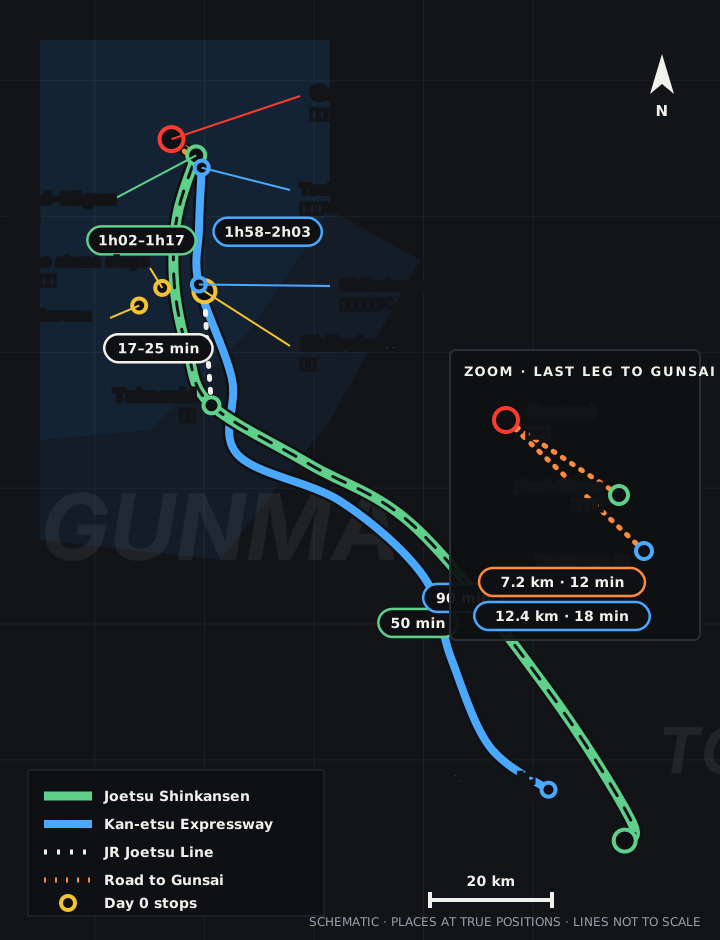
Where it all happens: Gunma

Why it still matters, and where to feel it
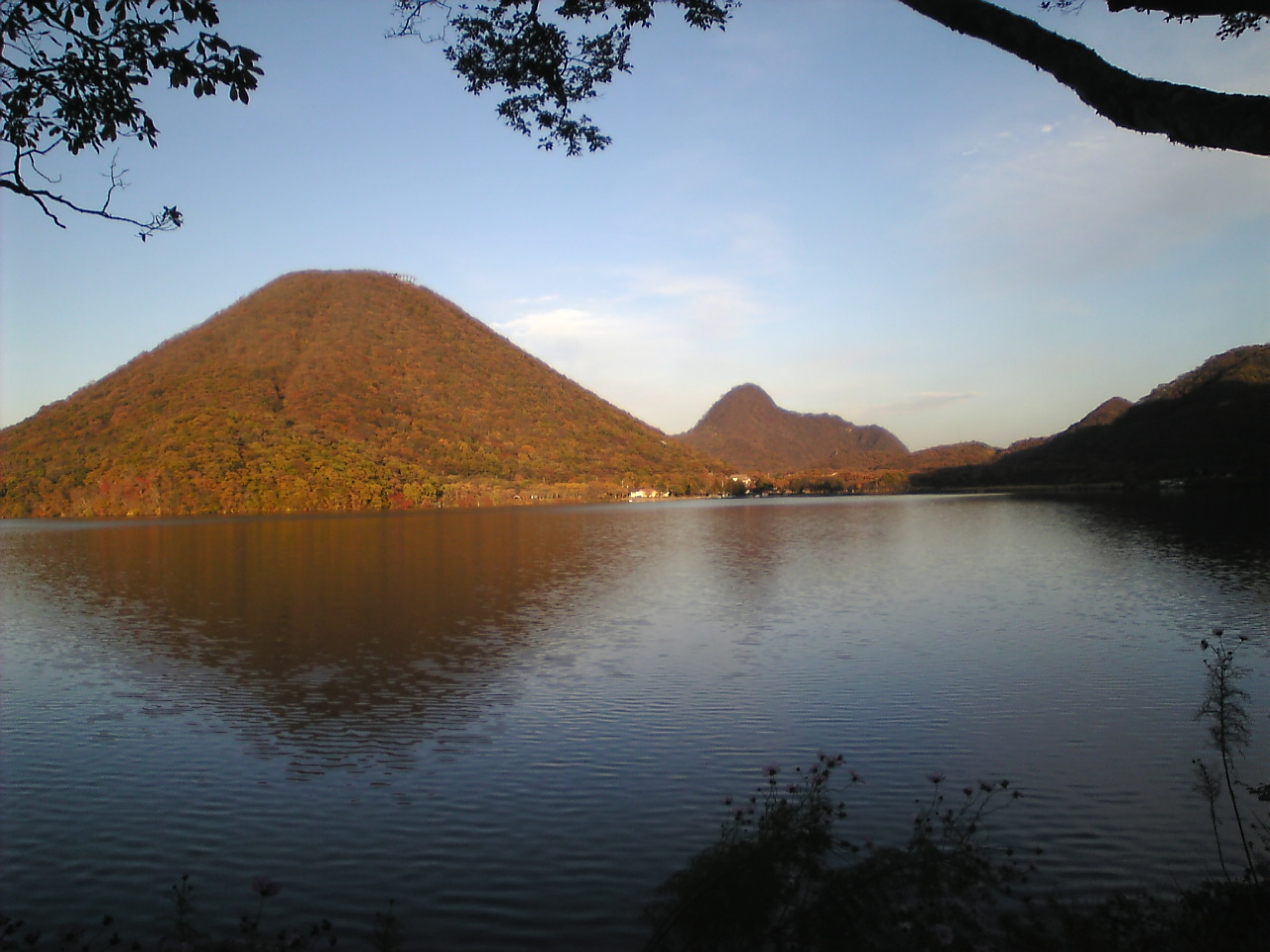
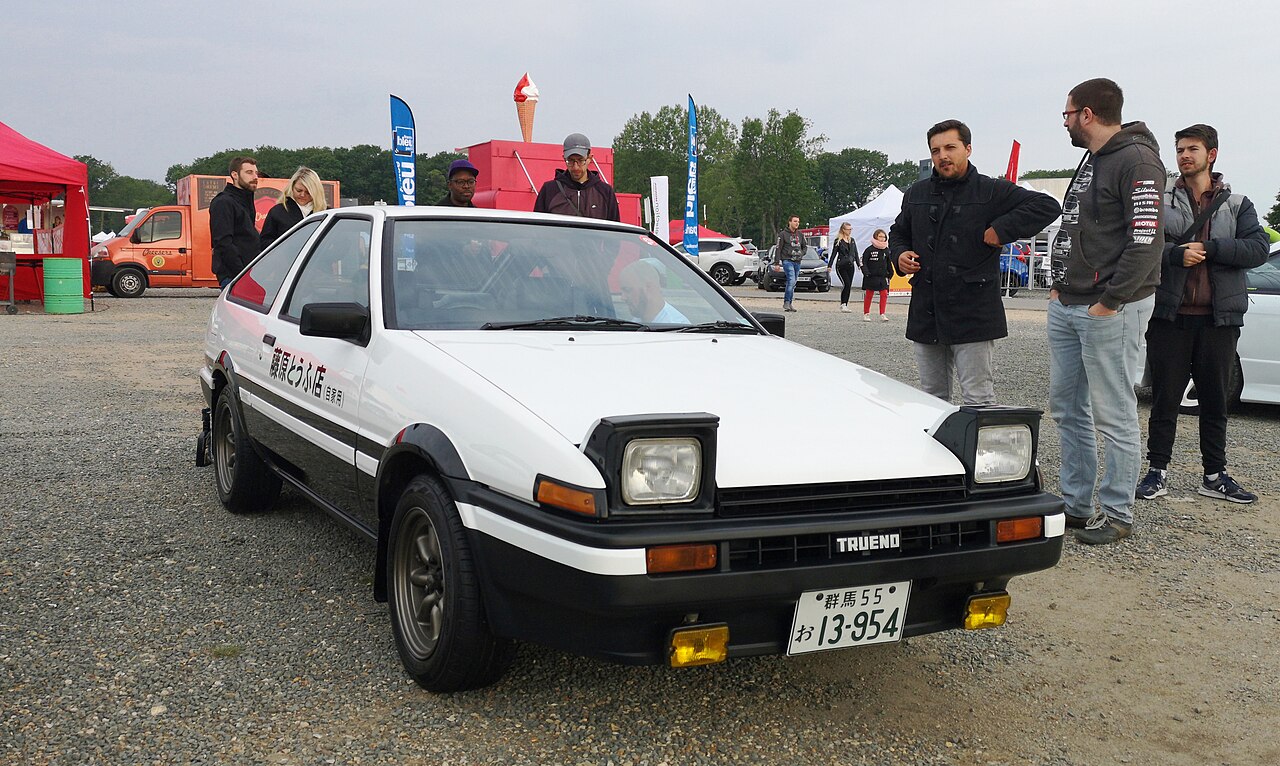
The AE86 never had much power. What it had was balance, light weight and a rear-drive layout that rewards a driver who can steer with the throttle. That is why it is still the touge car, forty years on, and why the Hachi-Roku keeps appearing in Hot-Version touge videos at Gunsai, the closed Gunma mountain course where we run our drift day.
Our drift-day cars are modified AE86s, each in a different build, driven by professional drivers. You sit in the passenger seat.
Book a ride Read: Gunsai history
Timeline
- 1970s. Drifting develops on Japanese mountain passes; Kunimitsu Takahashi is credited with its techniques.
- 1983. The AE86 Corolla Levin and Sprinter Trueno go on sale (production ran to 1987).
- 1987. Pluspy’s video of Keiichi Tsuchiya’s touge driving becomes a hit.
- 1988. Ikaten, an early drifting event, is organised.
- 1995. Initial D begins; Shuichi Shigeno’s manga puts a Trueno on the pass.
- 1996. A drift demonstration at Willow Springs takes the sport overseas.
- 2017. MF Ghost, the Initial D sequel, begins.
Quick answers
How much power-to-weight does a naturally aspirated AE86 have?
A stock AE86 has about 122–144 PS per tonne (130 PS, 900–1,065 kg). Documented naturally aspirated circuit builds reach about 250–275 PS per tonne, with 220 PS at around 800 kg, more than a stock Skyline GT-R R34 (about 180) or Supra A80 (178–188 turbo).
Is a 16-valve or 20-valve 4A-GE better for an AE86?
The factory 16-valve 4A-GE makes 130 PS; the later 20-valve Silvertop makes 160 PS and the Blacktop 165 PS, and a 20-valve swap is a common street upgrade of about 150–160 PS. The serious naturally aspirated circuit builds we found stay on 16-valve heads, stroked to about 1.75–1.8 litres, with individual throttle bodies or carburettors, reaching 220 PS.
Did the AE86 beat the Skyline GT-R at Gunsai?
Reportedly yes in a 2003 Hot-Version test: a street-tuned AE86 of about 170 PS against a stock 280 PS R34, which could not pull away. The AE86 is not the outright fastest at Gunsai and has lost to cars such as a Techno Pro Spirit MR-S; see the Gunsai videos on this page for each result.
Sources and credits
- Toyota AE86, Wikipedia: models, years, engine, weight, rear-wheel drive.
- Drifting (motorsport), Wikipedia: Takahashi, Tsuchiya, 1987 video, Ikaten, Willow Springs.
- Keiichi Tsuchiya, Wikipedia: Drift King, Pluspy, Initial D supervision.
- Initial D, Wikipedia: manga, Takumi, Trueno, sales, MF Ghost.
- Toyota A engine, Wikipedia: 16V and 20V 4A-GE figures.
- Web Motor Magazine: Group A AE86 Levin: race-spec power, rules and the 1985 Inter TEC.
- Petrolicious: the first Japanese drifting video: further reading.
Toyota, Initial D, MF Ghost, Pluspy, D1 Grand Prix and other names belong to their owners. Tokyo to Touge is independent and is not affiliated with, endorsed by or sponsored by them. We do not reproduce their images or video; follow the links to see them at the source. Wikipedia pages can change and some carry notes asking for more citations, so treat enthusiast claims as such. Photo: Tokyo to Touge (our own image).
クルマについて
AE86は、1983〜1987年に作られたトヨタ・カローラレビンとスプリンタートレノの型式コードです。2車は兄弟で、レビンは固定式ヘッドライト、トレノはリトラクタブル。どちらもクーペとリフトバックがありました。日本仕様は1.6L DOHCの4A-GE(130PS)、車重は仕様により約900〜1,065kgです(Wikipedia)。
ドリフトの要は、「最後の後輪駆動カローラ」だったこと。同世代のほかのカローラは前輪駆動に移り、AE86は小さく軽く安い後輪駆動のクーペとして残りました。日本ではハチロク(8-6)と呼ばれます。
ドリフトの起源
ドリフトは1970年代、日本の峠から育ちました。元オートバイレーサーの高橋国光さんが走りの技術を築いたとされ、これに憧れた土屋圭市さんが峠で腕を磨いて走り屋の伝説となり、「ドリキン(ドリフトキング)」と呼ばれるようになります(Wikipedia)。
1987年、プラスピーが発売した土屋さんの峠走行ビデオ(愛車はトレノ)が大ヒットし、多くのドライバーに影響を与えました。翌年には初期のドリフト専門イベント「イカ天」の開催に関わり、1996年にはアメリカ・ウィロースプリングスでのデモ走行で海外へ広がり、日本ではD1グランプリが始まりました。
頭文字Dと MFゴースト
1995年、しげの秀一さんが講談社の「週刊ヤングマガジン」で『頭文字D』の連載を開始。主人公の藤原拓海は、群馬の高校生で、父の古いスプリンタートレノで豆腐を配達しながら峠の走りを身につけます。舞台は群馬の峠で、地名は架空ですが実在の場所がモデルです。土屋圭市さんが監修に協力し、累計5,500万部超、アニメ・実写映画・アーケードゲームへと広がりました。続編『MFゴースト』は2017〜2025年に連載されました(Wikipedia)。
標準車のスペック(ノーマル基準)
ドリフトデーの車はすべて改造AE86で、仕様は車ごとに異なります(開催日ごとに公開)。ここでは出発点となるノーマルの国内仕様を、WikipediaとWikipediaに基づいて示します。
| エンジン | 1.6L(1,587cc)DOHC16バルブ 4A-GEU、圧縮比9.4:1、自然吸気 |
|---|---|
| 駆動 | FR(後輪駆動)、T50 5速MT、LSDはオプション |
| 寸法 | ホイールベース2,400mm、全長約4,185〜4,215mm、全幅1,625mm、全高1,335mm |
| サスペンション | 前:ストラット、後:4リンク式リジッドアクスル、前後スタビライザー |
| 重量配分 | 前後ほぼ50:50 |
この走りの理由
パワーウェイトレシオ
1トンあたり約120〜145PS。直線が速いわけではありませんが、動かす重さが小さいのでエンジンを常に使い切れます。
即応性
ターボのない自然吸気ツインカム。アクセルに即座に反応し、約7,500〜7,800rpmまで回る高回転型です。
軽快さ
短い2.4mのホイールベースと約900kgの車重で、向きを変えやすく、少ない力で回り込みます。
バランス
ほぼ前後50:50、後輪駆動、オプションのLSD。アクセルで曲げる車で、ドリフトを学ぶのに最適です。
16バルブ、20バルブ、レース仕様
| 16V 4A-GEU(AE86) | 20V シルバートップ(AE101) | 20V ブラックトップ(AE111) | グループA仕様AE86 | |
| 出力 | 130PS/6,600rpm | 160PS/7,400rpm | 165PS/7,800rpm | 約175PS/9,200rpm |
| トルク | 149Nm/5,200rpm | 162Nm/5,200rpm | 162Nm/5,600rpm | 非公表 |
| 圧縮比 | 9.4:1 | 10.5:1 | 11.0:1 | 非公表 |
| レッドゾーン | 約7,600rpm | 7,800rpm | 8,200rpm | 9,200rpm(最高出力時) |
| バルブ | 4気筒あたり4、可変なし | 5バルブ、吸気可変カム | 5バルブ、吸気可変カム | 16V+公認カム・ピストン・ECU |
| AE86換算PS/トン* | 122〜144 | 150〜178 | 155〜183 | 164〜194 |
*ノーマルのAE86車重0.9〜1.065トンで換算した目安。スワップで重量は変わり、レース車はより軽量です。数値の出典:Wikipedia、グループA:Webモーターマガジン。
「レース仕様」とは。1980年代の日本のグループAでは、AE86レビンは1.6L以下のディビジョン1で走りました。公認のカム、ピストン、ECUが使え、出力は約175PS/9,200rpmまで向上。足まわりは純正のストラット+リジッドアクスルの形式を守り、固めのバネとダンパー、ローギアのファイナル、大径タイヤで対応しました。1985年のインターTECでは出走38台中9台がAE86でした。フルチューンはさらに上を行き、N2仕様で約250PSをうたう販売車両もありますが、あくまで1台の例です。ドリフト車に決まった仕様はなく、仕様は車ごとに大きく異なるため、開催日ごとに各車の仕様を公開します。
軽さが峠を制す理由
狭い山道では、大パワーを使い切れる場面はほとんどありません。大事なのは、減速させ、曲げ、次のコーナーへ送り込む車体がどれだけ軽いか。それがAE86の強みです。
進入速度とブレーキについて、正直に
800kgのAE86は、同じ速度なら1,560kgのR34の約半分の運動エネルギーしか持たないので、毎回のコーナーでブレーキが処理する熱も半分です。ブレーキは熱ダレしにくく、長い下りでも安定します。前後ほぼ50:50で軽く、荷重移動が小さいので姿勢が乱れにくく、ブレーキングで向きを変えやすい車です。同じタイヤなら制動距離を決めるのはグリップで、重さではありません。AE86の強みは、安定して再現できることと、上手いドライバーがどれだけ遅く、自信を持ってブレーキできるかにあります。狭い道では旋回速度はグリップで決まるため、200〜220PSのAE86でも、はるかに高出力の車に迫れます。
筑波のタイム(注意付き)
| 筑波サーキット(TC2000) | タイム |
|---|---|
| ホンダNSX(NA1)チューニング車 | 53.474秒 |
| スカイラインGT-R(BNR34)チューニング車 | 54.481秒 |
| スープラ(JZA80)チューニング車 | 55.458秒 |
| シビック(EK9)チューニング車 | 55.964秒 |
| AE86「Kumomaka」約200hp・800kg | 57.063秒 |
| AE86 CBY 5.5A-G NA 220PS | 58.6秒 |
| AE86「カーボンジャンキー」NA 220PS | 59.234秒 |
チューニング車のタイムはWikipedia:筑波サーキットのタイムアタック表(出力の記載なし)。AE86はMotor Fan、The Drive、Speedhunters(Attack Tsukuba 2021)。タイヤや条件、年が異なるため目安です。NAのAE86は、2km周回でチューニングされたGT-R・スープラの3〜5秒以内に収まっています。
峠の原点
1985年のグループA「インターTEC」では、出走38台中9台がAE86。土屋圭市さんと鈴木恵一さんのアドバン・カローラは大排気量車と渡り合い追い抜きました(Webモーターマガジン)。その後、土屋さんが峠でハチロクを伝説にし、『頭文字D』が同じ群馬の峠に豆腐屋のトレノを走らせました。だからいまも「峠」といえばハチロクなのです。
すべてを並べて比較
このページの全ビルドと比較車を1つの表にまとめました。パワーウェイトレシオは公表出力÷重量、筑波はTC2000のタイムです。
| 車 | 出力 | 重量 | PS/トン | 筑波タイム |
|---|---|---|---|---|
| AE86 自然吸気の仕様 | ||||
| CBY 5.5A-G(1.8L・隼スロットル) | 220 PS | 約800 kg | 約275 | 58.6 s |
| 「カーボンジャンキー」(16V 4A-GE) | 220 PS | 未満 800 kg | 約275以上 | 59.234 s |
| 小泉商会 N2(1.75L・キャブ) | 220 PS | 810 kg | 約272 | 59.7 s |
| 「Kumomaka」* | 200 hp | 800 kg | 約250 | 57.063 s |
| 満作自動車 トレノ* | 約180 hp | 810 kg | 約222 | 約60.0 s |
| テックアート ストリート仕様 | 230 PS | 記載なし | — | — |
| 佐々木氏・後期AE92ヘッド | 160 PS | 記載なし | — | — |
| オーナー製作 AE111 20V換装 | 158 PS | 記載なし | — | — |
| AE86 基準 | ||||
| ノーマル 16V 4A-GEU | 130 PS | 900–1,065 kg | 122–144 | — |
| グループA仕様 | 約175 PS | 記載なし | — | — |
| チューニング車(筑波・セミスリック) | ||||
| ホンダ NSX(NA1) | 記載なし | 記載なし | — | 53.474 s |
| スカイラインGT-R(BNR34) | 記載なし | 記載なし | — | 54.481 s |
| スープラ(JZA80) | 記載なし | 記載なし | — | 55.458 s |
| シビック(EK9) | 記載なし | 記載なし | — | 55.964 s |
| 市販車(ノーマル) | ||||
| スカイラインGT-R R32/R33/R34 | 280 PS (公表値) | 1,430 / 1,530 / 1,560 kg | 196 / 183 / 180 | — |
| スープラ A80 ターボ / NA | 280 / 223 PS | 1,490–1,570 / 1,410–1,510 kg | 178–188 / 148–158 | — |
| RX-7 FD タイプR(最終) | 280 PS | 1,310 kg | 約214 | — |
| GR86(2022〜) | 231–235 PS | 1,270–1,307 kg | 177–185 | — |
*Speedhuntersの検索結果の抜粋に基づく数値で、記事自体は確認できていません。未確認として扱ってください。出力の単位は公表値(PSまたはhp)のままで、出典ごとに条件が異なります。チューニング車の出力は筑波の表に記載がありません。
要点:自然吸気のサーキット仕様AE86は1トンあたり約250〜275PSで、表中で最良の市販車より約40〜50%上。それでも筑波では、はるかに高出力のチューニング車に2.5〜6秒差まで迫ります。軽さ、バランス、高回転。だからハチロクは峠の基準なのです。
群サイのハチロク:映像が示すもの
日本のカービデオは、群サイで長年この議論に決着をつけてきました。ここに記録されているAE86の勝ち負けをそのまま紹介します。動画は埋め込まず、出典へのリンクでご覧いただけます。
- 2003年、ベストモータリング:第1回「峠最強伝説」決勝。200PSクラスで、出版元の公式ページは土屋さんのAE86が決勝を制したと記しています。スプーンのシビックEG6、テクノプロスピリットMR-S、インテグラタイプRなどが参戦しました。
- 2003年、ホットバージョン:土屋さんのAE86 対 ノーマルR34 GT-R。約170PSのストリートチューンAE86に対し、ノーマル280PSの四駆ツインターボR34。GT-Rは峠で離せず、峠のルールでは負けとされています(Japanese Nostalgic Car、二次情報。エンジン形式は不明)。対戦の動画:Gunsai Touge: AE86 vs R34 GT-R。
- 2026年、同じクルマ(別コース)。袖ケ浦フォレストレースウェイの濡れた路面で、土屋さんのAE86は、オプション誌が320〜360PSと推定した谷口信輝さんのチューンドR34と、より高出力の2台のAE86(170〜200PS)に勝ちました(同ソース)。
- 群サイ峠対決の正直な話。ホットバージョンの対決は最速を競う企画で、AE86は勝者というより基準です。土屋さんのAE86に初めて勝ったのはテクノプロスピリットのMR-S(1.8L・190hp)で、24.7〜26.1秒の最速組はFEED RX-7、J’s Racing S2000、R35 GT-Rなどです(HotCars)。
- もっと見る:映像は下の「群サイのAE86を観る」にまとめています。
170〜200PSの自然吸気AE86(良い16バルブや20バルブ仕様の出力)がすべてに勝つ、という話ではありません。狭い峠で、はるかに高出力の車を本気にさせる。それがあなたが乗る助手席です。
群サイのAE86を観る
以下の映像は、画面に入ると音なしの短いプレビューがVHS風のオーバーレイつきで流れます。スピーカーのボタンで音声をオンに、「プレーヤー」で通常の操作画面を開けます。各カードにチャンネル名と映像の種類を表示しています。出版元が結果を明記していない限り結果は記載しません。結果は各動画でご確認ください。
公式チャンネル・制作会社
独立系・チーム投稿
エンジン
ビデオオプション「AE86熱世界」は4A-Gを深掘りします。下の2本はエンジンの話で、群サイとは確認できていません。
群サイではないが、同じ物語
動画は各チャンネルに帰属します。プレビューとプレーヤーはYouTube(youtube-nocookie.com)から読み込まれ、訪問情報がGoogleに共有されます。端末が動きの軽減やデータ節約を求める場合は流れません。出典リストは2026年10月25日時点で、全編を視聴確認したものではありません。
舞台は群馬
いまも色あせない理由
AE86はパワーに恵まれたクルマではありません。あるのはバランスと軽さ、そしてアクセルで曲がる後輪駆動。だから約40年たった今も峠の象徴で、私たちがドリフトデーを走らせる閉鎖コース群サイでも、ホットバージョンの峠企画で登場し続けています。
当日走るのは、仕様の異なる改造AE86で、運転はプロ。あなたは助手席に乗ります。
よくある質問
自然吸気AE86のパワーウェイトレシオは?
ノーマルのAE86は1トンあたり約122〜144PS(130PS、900〜1,065kg)。記録のある自然吸気サーキット仕様は220PS・約800kgで約250〜275PS/トン。ノーマルのR34 GT-R(約180)やA80スープラ(ターボで178〜188)より上です。
AE86には16バルブと20バルブのどちらが良い?
純正16バルブ4A-GEは130PS、後継の20バルブはシルバートップ160PS、ブラックトップ165PS。20バルブ換装は150〜160PS級のストリート定番です。確認できた本格的な自然吸気サーキット仕様は16バルブヘッドのまま1.75〜1.8Lに排気量アップし、独立スロットルやキャブで220PSに到達しています。
群サイでAE86はスカイラインGT-Rに勝った?
2003年のホットバージョンの企画で、約170PSのストリートチューンAE86が、ノーマル280PSのR34に離されなかったと報じられています。ただしAE86は群サイの最速ではなく、テクノプロスピリットMR-Sなどに敗れたこともあります。各結果はページ内の群サイ動画でご確認ください。
出典とクレジット
- Toyota AE86(Wikipedia)
- Drifting(Wikipedia)
- Keiichi Tsuchiya(Wikipedia)
- Initial D(Wikipedia)
- Petrolicious
各名称は各権利者に帰属します。Tokyo to Touge は独立した企画で、これらの権利者とは提携・承認・協賛関係にありません。画像・映像は転載せず、出典先へのリンクでご覧いただけます。写真:Tokyo to Touge。(日本語は機械翻訳の下書きです。)
本页暂无中文译本,以下为英文原文。
The car
The AE86 is the chassis code for the Toyota Corolla Levin and Sprinter Trueno, built from 1983 to 1987. The two were near twins: the Levin had fixed headlights and the Trueno had pop-ups, and both came as a coupé or a liftback. Under the bonnet, the Japanese-market car had a 1.6-litre twin-cam 4A-GE engine rated at 130 PS, and the whole car weighed roughly 900 to 1,065 kg, depending on version, per Wikipedia.
The key fact for drifters: it was the last rear-wheel-drive Corolla. The rest of that generation moved to front-wheel drive, which left the AE86 as a small, light, cheap, rear-driven coupé. In Japan it is called Hachi-Roku, simply “eight-six”.
Where drifting came from
Drifting grew out of Japan’s mountain-pass (touge) driving in the 1970s. Former motorcycle racer Kunimitsu Takahashi is credited with developing its techniques on the track, and a young Keiichi Tsuchiya, inspired by him, practised on mountain roads until he became a street-racing legend and earned the nickname Dorikin, the Drift King (Wikipedia: Drifting, Wikipedia: Keiichi Tsuchiya).
In 1987 a video of Tsuchiya’s touge driving in his own Trueno, released by Pluspy, became a hit and influenced a generation of drivers. A year later he helped organise Ikaten, one of the first events dedicated to drifting. Drifting then spread abroad after a 1996 demonstration at Willow Springs in California, and a professional series, the D1 Grand Prix, followed in Japan. Enthusiast sites tell the 1987 story in more detail, for example Petrolicious.
Initial D and MF Ghost
In 1995 manga artist Shuichi Shigeno began Initial D in Kodansha’s Weekly Young Magazine. Its hero, Takumi Fujiwara, is a Gunma teenager who masters mountain passes while delivering tofu in his father’s old Sprinter Trueno. The story is set on Gunma’s passes, some names fictionalised but based on real places, and Keiichi Tsuchiya helped supervise it. The series sold more than 55 million copies and led to anime, a live-action film and many arcade games. Its sequel MF Ghost ran from 2017 to 2025 (Wikipedia: Initial D). The car’s fame, and its resale prices, climbed with it.
The default car: stock reference specs
Every drift-day car is a modified AE86 with its own build, and each date’s line-up is published. So here is the stock Japanese-market car they all start from, per Wikipedia and Wikipedia: Toyota A engine.
| Engine | 1.6 L (1,587 cc) DOHC 16-valve 4A-GEU, 9.4:1 compression, naturally aspirated |
|---|---|
| Layout | Front engine, rear-wheel drive, T50 5-speed manual, optional limited-slip differential |
| Wheelbase and size | 2,400 mm wheelbase, about 4,185–4,215 mm long, 1,625 mm wide, 1,335 mm high |
| Suspension | MacPherson struts at the front, four-link live axle at the rear, front and rear anti-roll bars |
| Weight balance | Close to 50/50 front to rear |
Power-to-weight is 130 PS divided by 0.9 to 1.065 tonnes. Wikipedia gives no official 0–100 km/h time, so we don’t quote one.
Why it feels the way it does
Power-to-weight
About 120–145 PS per tonne from a 1.6-litre. Not fast on a straight, but the car has so little to move that the engine is always working.
Instant response
A naturally aspirated twin-cam with no turbo to spool. The throttle answers straight away, and the engine pulls to a redline of roughly 7,500–7,800 rpm, so you keep it in the high revs.
Nimble
A short 2.4 m wheelbase and around 900 kg mean the car changes direction quickly and rotates with little effort. It is easy to send sideways and easy to catch.
Balance
Near 50/50 weight, rear-wheel drive and an optional limited-slip differential give a car you steer with the throttle, which is why it teaches drifting so well.
16-valve, 20-valve and race spec
The AE86 left the factory with the 16-valve 4A-GE. Many owners swap in the later 20-valve versions, and racers go much further. Typical figures:
| Engine | 16V 4A-GEU (AE86, 1983–87) | 20V Silvertop (AE101, 1991–95) | 20V Blacktop (AE111, 1995–2000) | Group A race AE86 |
|---|---|---|---|---|
| Power | 130 PS at 6,600 rpm | 160 PS at 7,400 rpm | 165 PS at 7,800 rpm | about 175 PS at 9,200 rpm |
| Torque | 149 Nm at 5,200 rpm | 162 Nm at 5,200 rpm | 162 Nm at 5,600 rpm | not published |
| Compression | 9.4:1 | 10.5:1 | 11.0:1 | not published |
| Redline | about 7,600 rpm | 7,800 rpm | 8,200 rpm | 9,200 rpm (peak power) |
| Valves and cam | 4 per cylinder, no variable cam | 5 per cylinder, variable intake cam | 5 per cylinder, variable intake cam | 16V with approved cams, pistons and ECU |
| PS per tonne in an AE86* | 122–144 | 150–178 | 155–183 | 164–194 |
*130–175 PS divided by 0.9 to 1.065 tonnes, the stock AE86 weight range. Swaps change the weight and race cars are lighter, so treat this as a guide. Engine figures from Wikipedia: Toyota A engine; the Group A figure from Web Motor Magazine.
What “race spec” means. In Group A touring-car racing in 1980s Japan, the AE86 Levin ran in the 1.6-litre Division 1 class. Teams could fit approved camshafts, pistons and engine electronics, which raised output to about 175 PS at 9,200 rpm, and had to keep the stock MacPherson front and rigid rear axle layout, with stiffer springs and dampers, shorter final drives and bigger-diameter tyres. At the 1985 Inter TEC, nine of the 38 starters were AE86s, and an Advan-backed Corolla driven by Keiichi Tsuchiya and Keiichi Suzuki ran with larger cars. Full-tune builds go further: one dealer listing for an N2-spec car claims about 250 PS, though that is a single car, not a standard. Drift cars have no single spec: builds vary widely, which is why we publish each car’s build for every date.
Why a lightweight rules the touge
On a narrow mountain road you rarely get to use big power. What counts is how little car you have to slow, turn and throw into the next corner. That is the AE86’s whole case.
| Car | Power | Weight | PS per tonne |
|---|---|---|---|
| AE86 stock (16V) | 130 PS | 900–1,065 kg | 122–144 |
| AE86 NA circuit builds, average of five | about 208 PS | about 804 kg | about 259 |
| AE86 CBY 5.5A-G | 220 PS | about 800 kg | about 275 |
| Skyline GT-R R32 / R33 / R34 | 280 PS (published) | 1,430 / 1,530 / 1,560 kg | 196 / 183 / 180 |
| Supra A80 twin turbo / NA | 280 / 223 PS | 1,490–1,570 / 1,410–1,510 kg | 178–188 / 148–158 |
| RX-7 FD Type R (final) | 280 PS | 1,310 kg | about 214 |
| GR86 (2022+) | 231–235 PS | 1,270–1,307 kg | 177–185 |
Sources: Skyline GT-R, Supra, RX-7, GR86, AE86 and the build sources in the table above. Nissan’s 280 PS GT-R figure is a published number under the Japanese “gentlemen’s agreement”; tests suggest the R34 made about 332 PS, which is about 213 PS per tonne. Builds use mixed measurement conditions.
Entry speed and braking, honestly
An 800 kg AE86 carries roughly half the kinetic energy of a 1,560 kg R34 at the same speed, so its brakes have half as much to shed on every corner. They run cooler, fade later and stay consistent down a long descent. With near 50/50 weight and a short wheelbase, there is also less weight to shift under braking, so the car stays settled and can be rotated on the brakes. Stopping distance on the same tyres is set by grip, not mass, so the AE86’s edge is repeatability and how late and how confidently a good driver can brake, not a magic shorter stop. On a tight road, cornering speed is limited by grip, which is why a 200–220 PS AE86 stays close to far more powerful cars.
Lap-time proof, with caveats
| Car at Tsukuba TC2000 | Time |
|---|---|
| Honda NSX (NA1), tuned, Nobuteru Taniguchi | 53.474 s |
| Skyline GT-R (BNR34), tuned | 54.481 s |
| Supra (JZA80), tuned | 55.458 s |
| Honda Civic (EK9), tuned | 55.964 s |
| AE86 “Kumomaka”, about 200 hp, 800 kg | 57.063 s |
| AE86 CBY 5.5A-G, naturally aspirated, 220 PS | 58.6 s |
| AE86 “Carbon Junkie”, naturally aspirated, 220 PS | 59.234 s |
Tuned-car times are from the time-attack table on Wikipedia: Tsukuba Circuit (street-tyre tuner cars; power not listed there). AE86 times: Motor Fan, The Drive, and a Speedhunters report of the Kumomaka car (Attack Tsukuba 2021). Tyres, conditions and years differ, so read this as a rough guide: the naturally aspirated AE86 is within about 3 to 5 seconds of tuned GT-Rs and Supras on a 2 km lap.
The touge originals
The proof is older than the game. In Japan’s 1985 Group A Inter TEC, nine of the 38 starters were AE86s, and the Advan Corolla of Keiichi Tsuchiya and Keiichi Suzuki kept pace with and passed bigger-engined cars (Web Motor Magazine). Tsuchiya then made the car a touge legend on the mountain roads, and Initial D put a tofu-delivery Trueno on those same Gunma passes (Wikipedia, Wikipedia). That is why the Hachi-Roku is still the car people mean when they say touge.
Everything side by side
Every build and reference car on this page in one table. Power-to-weight is published power divided by weight; Tsukuba times are TC2000 laps.
| Car | Power | Weight | PS per tonne | Tsukuba lap |
|---|---|---|---|---|
| AE86 builds, naturally aspirated | ||||
| CBY 5.5A-G (1.8 L, Hayabusa throttle bodies) | 220 PS | about 800 kg | 約275 | 58.6 s |
| “Carbon Junkie” (16V 4A-GE) | 220 PS | under 800 kg | 約275以上 | 59.234 s |
| Koizumi Shokai N2 (1.75 L, carburettors) | 220 PS | 810 kg | 約272 | 59.7 s |
| “Kumomaka”* | 200 hp | 800 kg | 約250 | 57.063 s |
| Mansaku Jidousha Trueno* | 約180 hp | 810 kg | 約222 | 約60.0 s |
| Tech Art street-comfort build | 230 PS | not stated | — | — |
| Sasaki, late AE92 head | 160 PS | not stated | — | — |
| Owner-built AE111 20V swap | 158 PS | not stated | — | — |
| AE86 reference | ||||
| Stock 16V 4A-GEU | 130 PS | 900–1,065 kg | 122–144 | — |
| Group A race AE86 | 約175 PS | not stated | — | — |
| Tuned reference cars (Tsukuba, semi-slicks) | ||||
| Honda NSX (NA1) | not listed | not listed | — | 53.474 s |
| Skyline GT-R (BNR34) | not listed | not listed | — | 54.481 s |
| Supra (JZA80) | not listed | not listed | — | 55.458 s |
| Civic (EK9) | not listed | not listed | — | 55.964 s |
| Stock road cars | ||||
| Skyline GT-R R32 / R33 / R34 | 280 PS (published) | 1,430 / 1,530 / 1,560 kg | 196 / 183 / 180 | — |
| Supra A80 turbo / NA | 280 / 223 PS | 1,490–1,570 / 1,410–1,510 kg | 178–188 / 148–158 | — |
| RX-7 FD Type R (final) | 280 PS | 1,310 kg | 約214 | — |
| GR86 (2022+) | 231–235 PS | 1,270–1,307 kg | 177–185 | — |
*Figures from search-result snippets of Speedhunters articles that we could not open; treat as unconfirmed. Power units are as published (PS or hp), conditions differ between sources, and the tuned cars’ power is not listed in the Tsukuba table. Sources: Motor Fan, Motor Fan, The Drive, Motor Fan, Automesse Web, Motor Fan, Wikipedia: Tsukuba Circuit, AE86, GT-R, Supra, RX-7, GR86.
The short version: the naturally aspirated circuit AE86s carry about 250–275 PS per tonne, roughly 40–50% more than the best stock road car here, yet lap Tsukuba 2.5 to 6 seconds behind far more powerful tuned cars. That mix of light weight, balance and revs is why it is the touge benchmark.
AE86s at Gunsai: what the videos show
Japan’s car videos have been settling the argument at Gunsai for years. Here is what is on record about AE86s there, wins and losses included. We link to the videos instead of embedding them, so you watch them at the source.
- 2003, Best MOTORing: the first Touge Saikyo Densetsu final. In the class up to 200 PS, the publisher’s own page says Tsuchiya’s AE86 won the final, against entries including a Spoon Civic EG6, a Techno Pro Spirit MR-S and an Integra Type R.
- 2003, Hot-Version: Tsuchiya’s AE86 vs a stock R34 GT-R. A street-tuned AE86 with roughly 170 PS faced a stock 280 PS, all-wheel-drive, twin-turbo R34. The GT-R could not pull away on the touge, which counts as a loss under touge rules (Japanese Nostalgic Car, a secondhand account; the engine type isn’t specified). A YouTube upload of the matchup: Gunsai Touge: AE86 vs R34 GT-R.
- The same car, 2026 (a different track). At Sodegaura Forest Raceway on a damp surface, Tsuchiya’s AE86 beat Nobuteru Taniguchi’s tuned R34, which Option magazine estimated at 320–360 PS, and two other AE86s rated 170–200 PS. Same source (Japanese Nostalgic Car).
- Gunsai Touge Showdown, the honest part. The Hot-Version showdown is a hunt for the quickest car, and the AE86 is the benchmark rather than the winner. The first car to beat Tsuchiya’s AE86 on its home course was a Techno Pro Spirit MR-S with a 190 hp 1.8-litre, and the quickest times, 24.7 to 26.1 seconds, belong to cars such as the FEED RX-7, J’s Racing S2000 and an R35 GT-R (HotCars).
- More to watch: every film is embedded in Watch the AE86 at Gunsai, below.
The point is not that a 170–200 PS naturally aspirated AE86, the output of a good 16-valve or 20-valve build, wins everything. It is that, on a narrow touge, it keeps a much more powerful car honest, and that is exactly the passenger seat we put you in.
Watch the AE86 at Gunsai
Each film below shows a short muted preview as it scrolls into view, with a VHS overlay. Tap the speaker to turn the sound on, or open the full player for controls. Every card names the channel and says what kind of footage it is. Results are not stated unless the publisher states them; see each video for the outcome.
Official channels and producers
Independent and team footage
The engines
Video Option’s AE86 Netsu Sekai series goes deep on 4A-G builds. These two are about the engines, and the venue isn’t confirmed as Gunsai.
Not at Gunsai, but the same story
Videos belong to their channels. Previews and players load from YouTube (youtube-nocookie.com), which shares your visit with Google; they stay off if your device asks for reduced motion or data saving. Source list compiled 25 Oct 2026; we have not watched every minute of every film.
Where it all happens: Gunma
Why it still matters, and where to feel it
The AE86 never had much power. What it had was balance, light weight and a rear-drive layout that rewards a driver who can steer with the throttle. That is why it is still the touge car, forty years on, and why the Hachi-Roku keeps appearing in Hot-Version touge videos at Gunsai, the closed Gunma mountain course where we run our drift day.
Our drift-day cars are modified AE86s, each in a different build, driven by professional drivers. You sit in the passenger seat.
Book a ride Read: Gunsai history
Timeline
- 1970s. Drifting develops on Japanese mountain passes; Kunimitsu Takahashi is credited with its techniques.
- 1983. The AE86 Corolla Levin and Sprinter Trueno go on sale (production ran to 1987).
- 1987. Pluspy’s video of Keiichi Tsuchiya’s touge driving becomes a hit.
- 1988. Ikaten, an early drifting event, is organised.
- 1995. Initial D begins; Shuichi Shigeno’s manga puts a Trueno on the pass.
- 1996. A drift demonstration at Willow Springs takes the sport overseas.
- 2017. MF Ghost, the Initial D sequel, begins.
Quick answers
How much power-to-weight does a naturally aspirated AE86 have?
A stock AE86 has about 122–144 PS per tonne (130 PS, 900–1,065 kg). Documented naturally aspirated circuit builds reach about 250–275 PS per tonne, with 220 PS at around 800 kg, more than a stock Skyline GT-R R34 (about 180) or Supra A80 (178–188 turbo).
Is a 16-valve or 20-valve 4A-GE better for an AE86?
The factory 16-valve 4A-GE makes 130 PS; the later 20-valve Silvertop makes 160 PS and the Blacktop 165 PS, and a 20-valve swap is a common street upgrade of about 150–160 PS. The serious naturally aspirated circuit builds we found stay on 16-valve heads, stroked to about 1.75–1.8 litres, with individual throttle bodies or carburettors, reaching 220 PS.
Did the AE86 beat the Skyline GT-R at Gunsai?
Reportedly yes in a 2003 Hot-Version test: a street-tuned AE86 of about 170 PS against a stock 280 PS R34, which could not pull away. The AE86 is not the outright fastest at Gunsai and has lost to cars such as a Techno Pro Spirit MR-S; see the Gunsai videos on this page for each result.
Sources and credits
- Toyota AE86, Wikipedia: models, years, engine, weight, rear-wheel drive.
- Drifting (motorsport), Wikipedia: Takahashi, Tsuchiya, 1987 video, Ikaten, Willow Springs.
- Keiichi Tsuchiya, Wikipedia: Drift King, Pluspy, Initial D supervision.
- Initial D, Wikipedia: manga, Takumi, Trueno, sales, MF Ghost.
- Toyota A engine, Wikipedia: 16V and 20V 4A-GE figures.
- Web Motor Magazine: Group A AE86 Levin: race-spec power, rules and the 1985 Inter TEC.
- Petrolicious: the first Japanese drifting video: further reading.
Toyota, Initial D, MF Ghost, Pluspy, D1 Grand Prix and other names belong to their owners. Tokyo to Touge is independent and is not affiliated with, endorsed by or sponsored by them. We do not reproduce their images or video; follow the links to see them at the source. Wikipedia pages can change and some carry notes asking for more citations, so treat enthusiast claims as such. Photo: Tokyo to Touge (our own image).